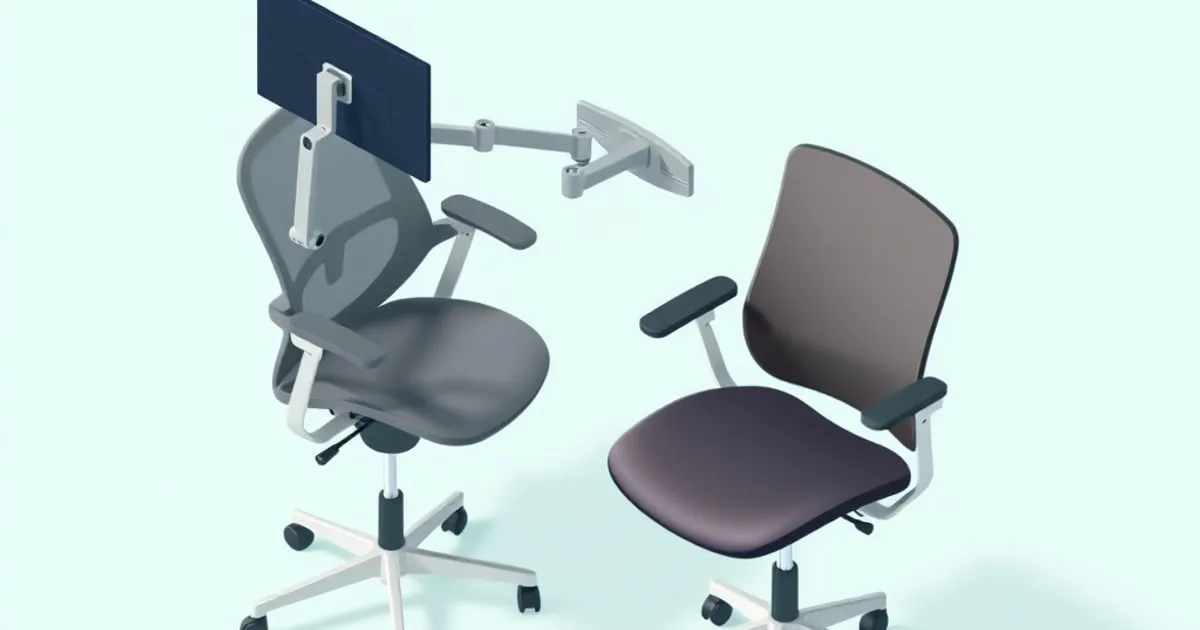
Herman Miller Aeron vs Steelcase Leap: Spec Comparison
Aeron vs Steelcase Leap V2 on the specs that affect pain: lumbar type, seat depth, mesh vs foam, recline mechanics, and who each chair fits.
The herman miller aeron vs steelcase leap debate occupies a specific bracket: both chairs cost $1,200–$1,800 new, carry 12-year warranties, and show up on every “best ergonomic chair” list. Neither is universally better. The right choice depends on your body dimensions, pain pattern, and how you actually sit through a workday. This breakdown focuses on the specs that affect long-session comfort and skips the brand mythology. If you are starting from the pain rather than from these two models, the wider spec checklist is in best ergonomic office chair for back pain.
If your pain is persistent or affects function, see a clinician before buying a chair — no chair adjustment substitutes for a diagnosis.
Who Each Chair Is For
Aeron: Best if you run warm, sit in a relatively consistent upright posture for 4+ hours, and can get sized correctly. The chair comes in three fixed sizes — A, B, and C — and seat depth is not adjustable within a size. Size B fits roughly 5’3”–6’1” at 125–275 lbs. Size C handles larger frames up to 350 lbs. If you are between sizes, seat fit can be a problem.
Leap V2: Better fit if you shift postures throughout the day — leaning forward for focused work, reclining for calls, rotating to reach a second screen. The seat depth slides through a 3-inch range, which absorbs the sizing ambiguity the Aeron does not. Upper-back and mid-back tension tend to respond better to the Leap’s dynamic support than to the Aeron’s fixed lumbar pads.
Both chairs are genuinely ergonomic — not in the marketing sense, but in the measurable sense: they meet BIFMA X5.1 structural standards, provide height-adjustable lumbar, and offer 4D armrests. The differences lie in how they deliver support and what bodies they fit.
Specs That Matter
| Spec | Aeron (Size B) | Leap V2 |
|---|---|---|
| Seat height range | ~16”–20.5” (41–52 cm) | ~15.5”–20.5” (39–52 cm) |
| Seat depth | 17” fixed | 15.75”–18.75” (3” adjustable) |
| Lumbar type | PostureFit SL: sacral + lumbar pads, independently adjustable | LiveBack + height-adj. lumbar: 5.25”–10.25” from seat; firmness dial |
| Armrests | 4D (height, width, depth, pivot) | 4D (height, width, depth, wider pivot range) |
| Recline mechanism | Harmonic 2 Tilt, tilt limiter, forward tilt | Natural Glide System, 4 recline stop angles + upright lock |
| Back material | 8Z Pellicle mesh (full mesh back and seat) | Fabric over flexible plastic frame |
| Weight capacity | 350 lbs (Size B/C) | 400 lbs (Leap Plus: 500 lbs) |
| Warranty | 12 years, 3-shift | 12 years, multi-shift |
| Approximate new price | ~$1,500–$1,800 | ~$1,200–$1,500 |
Specs sourced directly from Herman Miller’s Aeron spec sheet and the Steelcase Leap product page.
Lumbar Support: Two Different Approaches
The Aeron’s PostureFit SL is the most specific lumbar system at this price point. It uses two independently adjustable pads: one for the sacral region (the flat bone at the base of the spine) and one for the lumbar curve. You set them once to the position that feels right and they stay put. If your lower back responds to precise, firm, fixed support — common with lumbar disc issues — this is the stronger choice.
The Leap V2 uses Steelcase’s LiveBack technology: the backrest is split into upper and lower sections that flex independently as you move. When you recline, the lower section curves outward to track your lumbar spine rather than pulling away from it. A separate height dial (adjustable from 5.25” to 10.25” above the seat surface) positions the support band. A firmness dial controls how much the lower back section pushes against you.
The practical difference: the Leap’s system stays relevant across positions, while the Aeron’s pads are calibrated for one posture. If you spend three hours writing and two hours on calls with a different recline angle, the PostureFit SL is less likely to be hitting the right spot during the second block. The five lumbar mechanisms these two chairs represent, and how to tell them apart from a product listing, are broken down in lumbar support office chairs.
Seat Depth and Sizing
OSHA’s computer workstation guidelines specify that seat depth should support most of the thigh without the front edge contacting the back of the knee — a waterfall edge design addresses this, but depth adjustability gives you more room to fit different leg lengths.
The Aeron’s seat depth is fixed per size: 16” on size A, 17” on size B, 18.5” on size C. Users with long femurs relative to their height may find the B seat either cuts into the back of the knees or forces them to sit forward and lose lumbar contact. There is no workaround within a given size.
The Leap V2’s seat slides forward and back through roughly 3 inches. That range covers most of the variation that falls between Aeron sizes without requiring you to size up or down the entire chair.
Heat and Breathability
The Aeron’s 8Z Pellicle mesh covers both the seat and backrest. The weave is open enough to allow meaningful airflow across the entire seating surface. For users who run warm, work without air conditioning, or sit more than 6 hours daily, this is a real and lasting comfort difference.
The Leap V2 uses foam cushioning over a flexible plastic frame, covered in fabric. Foam and fabric trap body heat over long sessions. The foam provides slightly better initial pressure distribution for users with irregular pressure point issues, but it compresses over time and retains heat in a way mesh does not.
If you have ever left a fabric chair with a sweat-damp back after a long session, that experience does not improve with a $1,500 chair unless the material changes. The Aeron’s mesh is one of the few ergonomic chair features that translates directly to comfort across body types.
Recline Mechanics
The Leap’s Natural Glide System is the most underappreciated engineering difference between these two chairs. When you recline, the seat pan slides slightly forward — keeping your pelvis in neutral and maintaining the same contact point between your lumbar spine and the backrest. Conventional pivot-based reclines rotate you around a fixed axis, which can shift lumbar support contact and let the lower back pull away from the pad.
The Aeron’s Harmonic 2 Tilt counterbalances recline against body weight, which reduces the need to manually set tilt tension for each user. It also includes a forward tilt option that angles the seat pan downward — useful for leaning into a keyboard or for users with tight hip flexors. The Aeron’s forward tilt is rarely mentioned but affects neutral pelvis positioning for users who spend most of their time leaning slightly forward.
Refurbished Market
Both chairs have established refurbished markets through certified dealers. Refurbished Aerons from dealers typically run $400–$800 depending on condition, size, and options. Refurbished Leap V2 units run in a similar range.
Foam in the Leap cushion compresses over years of use. When buying used, ask the seller about foam condition or whether the seat has been refurbished. The Aeron’s 8Z Pellicle mesh sags less than foam under comparable use, which gives it a durability edge in the used market.
Compared To
Branch Ergonomic Chair ($359–$389): Legitimate 4D arms, height-adjustable lumbar, and seat depth adjustment at roughly a quarter of the price. The mesh quality and lumbar precision are lower, and the 275 lb weight limit is a constraint for some users. For someone sitting under 5 hours daily without active pain, the price difference is hard to justify. For anyone sitting 7–9 hours daily with existing lumbar issues, the gap closes.
Humanscale Freedom (~$1,400): Self-weighting recline mechanism that adjusts tilt tension automatically based on body weight. Worth considering for committed recliners who do not want to set tilt tension manually. The lumbar is passive/self-adjusting rather than user-set, which makes it less suitable for users with specific lumbar requirements.
Both alternatives sit inside wider price brackets worth reading before committing to either flagship: the sub-$1,000 field is ranked in best ergonomic chairs under $1,000, and the cheapest chairs that still carry real adjustment are in best budget ergonomic chair. Seating biomechanics across a wider set of brands is covered by our sister site ErgoChairGuide.
The Decision
Buy the Aeron if: you run warm, sit in a consistent posture, and can get correctly sized. The PostureFit SL provides the most targeted sacral-lumbar support at this price point, and the mesh outperforms every fabric option over multi-hour sessions.
Buy the Leap V2 if: you shift positions constantly, experience mid-back or upper-back tension rather than lumbar pain, or need seat depth adjustability to fit a body that falls between Aeron sizes. The Natural Glide System is a measurable improvement over pivot-based recline for users who actually recline.
Both are 12-year warranted chairs with legitimate adjustability. Neither fixes a clinical diagnosis. If your pain is affecting daily function, see a clinician before spending $1,500 on a chair.
Related across the network
- Best Ergonomic Office Chair for Lower Back Pain: Spec Guide — homedeskguide.com
- Building a Desk-and-Chair Combo Around Your Room, Not a Price Tag — homedeskguide.com
- Herman Miller Flo Plus vs Humanscale M2.1 vs Ergotron LX — monitorarmguide.com
- Best Filament for Beginners: What to Buy First — 3dfilamentguide.com
- Filament Density: Convert Spool Weight to Length — 3dfilamentguide.com
Sources
Related

Lumbar Support Office Chairs: How to Judge Back Support
Lumbar support is the chair spec that decides real back support. Here is how the mechanisms differ, where the pad belongs, and what to fix first.

Best Budget Ergonomic Chair 2026: Four Picks Under $450
Best budget ergonomic chair picks for 2026 under $450, compared spec by spec: lumbar adjustability, seat depth, armrest range, and what fails first.

Best Ergonomic Office Chair for Back Pain: Key Specs
Seat depth, lumbar adjustment, recline, fit, and warranties are compared across chairs for back pain from budget to premium tiers.